A few years ago I was in the changing rooms at the gym when I noticed a pill-strip laying on the floor. Concerned that children also use the changing rooms and might get their hands on whatever the medication was, I picked it up to throw away. But curiosity got the better of me & I flipped the strip over to see what the medication was.
It turned out to be a generic form of viagra, the famous erectile dysfunction medication. Now, to be clear, the strip was empty so there was no threat after all. But I was intrigued. What was going on in the changing rooms that warranted the use of this medication? The natural conclusion to reach was that there was some kind on homo-erotic thing going on. But I’m not comfortable jumping to conclusions and I am inherently curious. So, I did some digging…
It turns out that body builders often use this medication to raise their blood pressure which makes them look more muscular. Which in turn, made me wonder what is going on the mind of someone who takes medications to improve their self-image.
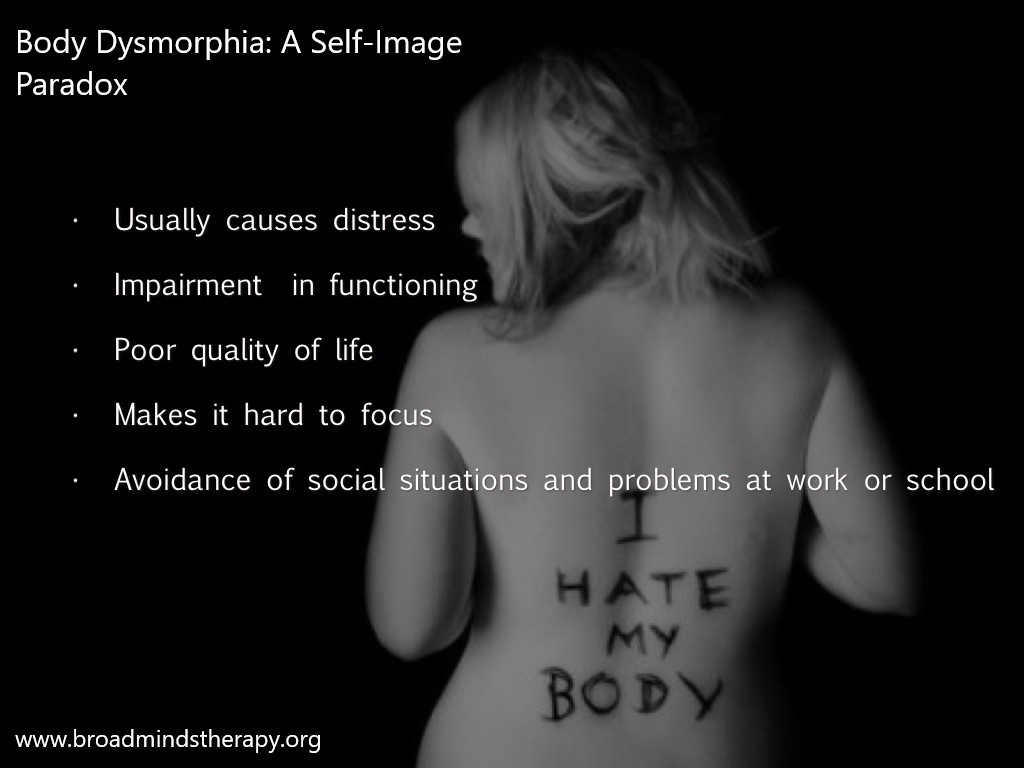
These are not easy times to live in for those who are very image conscious. Most magazines and newspapers celebrate celebrities for their looks or enjoy making fun of them when they’re caught in a less flattering light.
Social media is awash with people airbrushed and filtered to within an inch of their lives, people often looking nothing like their profile pictures. And no one seems to appear on TV these days with a hair out of place.
Every single one of us has, at one point or another, looked at someone else and considered their appearance, and compared our own appearance or shape favourably or less so.
There’s not necessarily anything wrong with that, as long as we don’t use our impressions to judge others or ourselves. There is a point, however, at which our appreciation for physical appearance can lead us into trouble.
Body Dysmporhic Disorder (BDD) has 2 sub-types:
- Muscle Dysmorphia (MD)|: We’ve all seen people who are built like the proverbial tank or perhaps lean but with a very toned musculature. To be clear we are not saying that anyone like this has MD. But it is surprisingly common and it is becoming an increasing problem.
Around 10 – 12% of weightlifters are thought to have MD, sometimes referred to colloquially as Bigorexia, and worryingly, a 2019 study found that 22% of young men aged between 18 & 24 had muscle-oriented eating disorder issues. In short, getting buff or hench was driving behaviours related to the fulfilment of basic needs. Despite what such people may tell you, their primary motivations were no longer about health & fitness. They are about size, primarily getting bigger, with many sufferers believing that they are small or weak despite what others may see & think.
The International OCD Foundation recognise the following:
Muscle dysmorphia is associated with a number of thoughts and beliefs about one’s self and others, including:
- Beliefs that one’s body is not sufficiently muscular and large enough
- Over valuing appearance
- Intrusive negative thoughts about one’s body that leads to distractibility and difficulty focusing attention
- Belief that other’s negatively evaluate their appearance
There are also a number of behavioral signs of muscle dysmorphia, including:
- Excessively working out/lifting weights (multiple hours per day)
- Repeatedly counting calories
- Avoiding eating out at restaurants due to perceived lack of control over food content
- Balancing carbohydrates, fats, proteins, and vitamins to achieve a “perfect” formula
- Eating multiple meals throughout the day at rigidly adhered to schedules
- Excessively checking mirrors, or other reflective surfaces
- Avoidance of mirrors, or other reflective surfaces
- Avoidance of social situations where bodies may be on display (e.g., the beach, or pool)
- Camouflaging one’s bodies by wearing multiple layers of clothing to appear “larger”
- Use of anabolic steroids or other appearance and performance enhancing drugs
Other features of MD:
- Gender: Muscle dysmorphia primarily affects men, although women can also suffer from the disorder.
- Age: The onset of muscle dysmorphia is typically in late adolescence, although it can also develop later in life.
- Race and Ethnicity: Although cultural studies are needed, patients with muscle dysmorphia represent various racial and ethnic groups. It is not exclusive to one group.
- Socioeconomic Status: Muscle dysmorphia seems to affect men and women from all socioeconomic levels.
- Sexual Orientation: Both heterosexual and homosexual men suffer from muscle dysmorphia.
- Education: Various levels of education are represented in individuals who struggle with muscle dysmorphia.
Disorders commonly seen along with Muscle Dysmorphia:
- Obsessive-Compulsive Disorder
- Substance abuse
- Eating Disorders (Restrictive eating, bulimia nervosa, binge eating disorder)
- Mood Disorders (Depression, Bipolar Disorder)
- Social Anxiety Disorder
- Attention Deficit Hyperactivity Disorder (ADHD)
How muscle dysmorphia is different healthy bodybuilding or fitness:
- Inaccurate body image and perception
- Self-esteem is almost entirely rested on muscle build, while other factors (intelligence, sense of humor, relationships etc) are discounted.
- Interference of MD behaviors with job, school, and relationships rather than being integrated in one’s life.
- Use of dangerous substances, such as anabolic steroids, that are clearly contraindicated for a healthy lifestyle.
2. Body Dysmorphia By Proxy: This is a lesser-known variant of BDD whereby an individual becomes obsessed with the appearance of another individual, typically a partner or child. It also often the case that the sufferer has also experienced issues with BDD or OCD at some point in the past.
Thankfully, there are effective treatments available. These typically include Cognitive Behavioural Therapies and involve controlled exposure to triggers or EMDR which targets dysfunctionally stored memories which may be at the root of the problem.
If you would like to talk about Body Dysmorphia or any other mental health issue please call 0899420568, email help@broadmindstherapy.org for a free, private, confidential & discrete discussion. You can also visit our facebook page https://www.facebook.com/jpbroad for more information.
Finally, thank you for taking the time to read this. Please like & share to help us reach & help as many people as possible.

 Integrative Counselling And Psychotherapy
A purposeful message.
LikeLike