

It’s the white-knuckle moment on a rollercoaster ride. The sudden fright when watching a thriller.
And, if you’ve ever stepped off the kerb to suddenly seen a car coming your way at a rate of knots, you’ll know the feeling well. Something like this happens next:
- Your heart rate goes through the roof.
- You immediately sense a tension in your body.
- You are suddenly hyper-alert.
- You instinctively step back on to the kerb, or…
- You freeze on the spot and your fate is now in the hands of the driver.
This is commonly known as The Fight or Flight instinct and is your experience of anxiety. It is your natural ability to automatically configure your bodily functioning to protect you as best it can which is thought to have evolved in our earliest ancestors.
When a threat is perceived, a cascade of hormones wash through the body preparing it to deal with the threat and in this way it is a life-preserving instinct.
It can prime the body for physical exertion needed to escape a situation or stand & fight if needed – This is the Fight or Flight effect.
But crucially, it can also cause you to freeze or flop, which are two effects less well known & understood. It is the subconscious drive that adopts the better to stay still or play dead approach. Perhaps a good example of this might be when a rape victim seems to submit to the attacker. In fact, it is not an acceptance of the situation but an instinctive inability to do anything but submit – the body & mind consider that to be the best option for survival. It is not necessarily conscious decision.
However, the days have long gone when the threats our primitive ancestors faced are a problem for us. We can & often do perceive modern problems as threats, like relationship problems, job insecurity, shopping, among many other issues; And sometimes, seemingly mundane situations like standing in a queue at the supermarket, can trigger this process, too.
It is easy, then, to see how the circumstances we now find ourselves in are enough to kick start our experiences of anxiety.
There are many ways in which anxiety can manifest itself but these can broadly be categorised as follows:
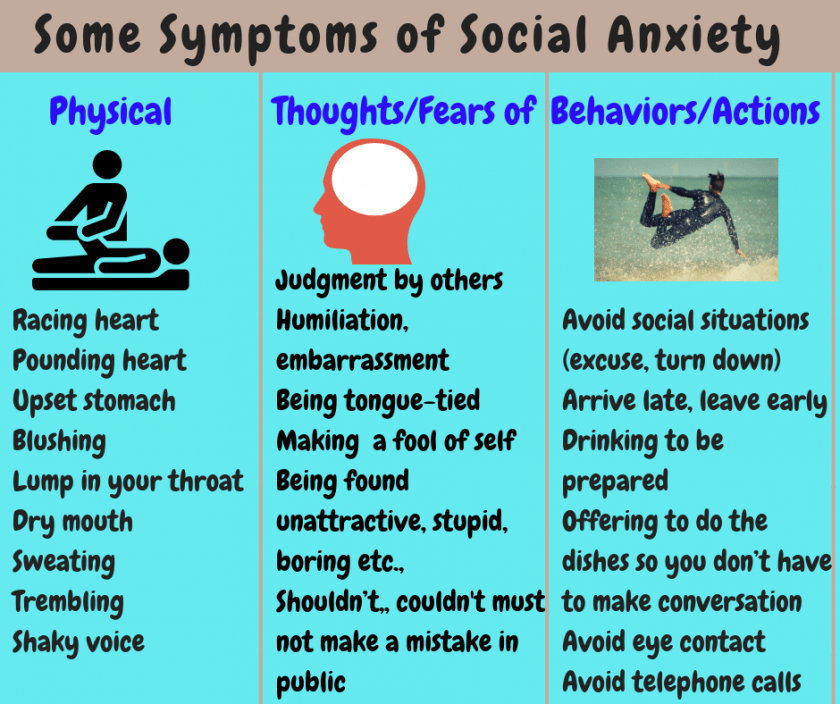
Anxiety can also be categorised by the various circumstances that trigger anxious episodes. For example:
Social Anxiety is characterised by feelings of anxiety when anticipating being in a social environment or during that situation. If we consider how our social circles narrowed during the Coronavirus pandemic, we can see how people might struggle with social anxieties. Some people have reported feeling anxious because they feel like they’ve lost the ability to communicate as well; Anticipating difficulty in engaging in small talk due to a lack of practise.
Phobias are another manifestation of anxiety. These are usually triggered by a known artefact. For example, a fear of transmission of disease at the moment could cause people to avoid touching common surfaces, avoiding contact with others or employ a number of behaviours that are designed to protect them from the perceived danger. If these thoughts, feelings and behaviours persist after the dangers have passed, these become dysfunctional and can have very real implications for your ability to meet your responsibilities and routinely function. Often the sufferer will know that the object of their fears represents no threat and yet they are terrified by that very thing.
Obsessive Compulsive Disorder (OCD) is another manifestation of anxiety. It is characterised by:
- Obsession – An overwhelming thought or series of thoughts that dominate the mind.
- Anxiety – The thought or thoughts generate great anxiety.
- Compulsion – A set of behaviours that must be completed to alleviate the anxiety & distress.
- Temporary Relief – The anxiety & distress experienced are only temporarily relieved by the behaviours aimed at easing the overwhelming thoughts, anxiety & distress.
Panic Attacks are a potential event that arises when anxiety becomes self-perpetuating and the sufferer has limited or no ability to interrupt that process. The thoughts & feelings drive what feels like an ever-worsening experience of terror. It can leave sufferers feeling like they are dying, perhaps having a heart attack or suffocating, or feeling trapped in a terrifying situation, even if that isn’t the case.
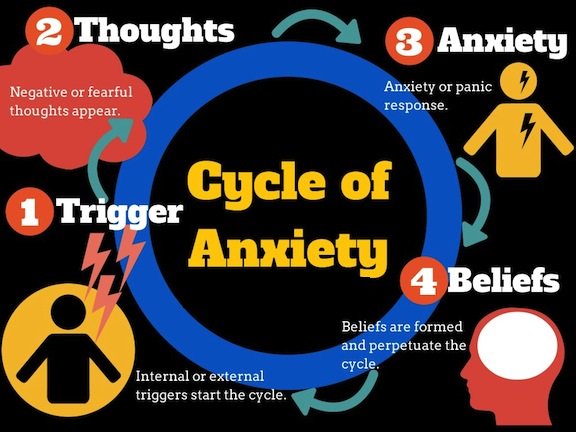
Anxiety can operate in a cycle whereby a trigger kickstarts a thought or feeling, which is recognised subconsciously or otherwise, as something to be anxious about. Then a belief can be installed in the mind that the trigger, object or situation associated with it represents some kind of danger. From that point, the belief is enough to trigger further anxieties. From here, an anxiety cycle can be established which sustains itself and can spiral out of control & lead to a panic episode.
The anxieties we feel can lead us to strive for greater control over things that affect us which can lead to thinking styles that can also drive anxiety. These are as follows:
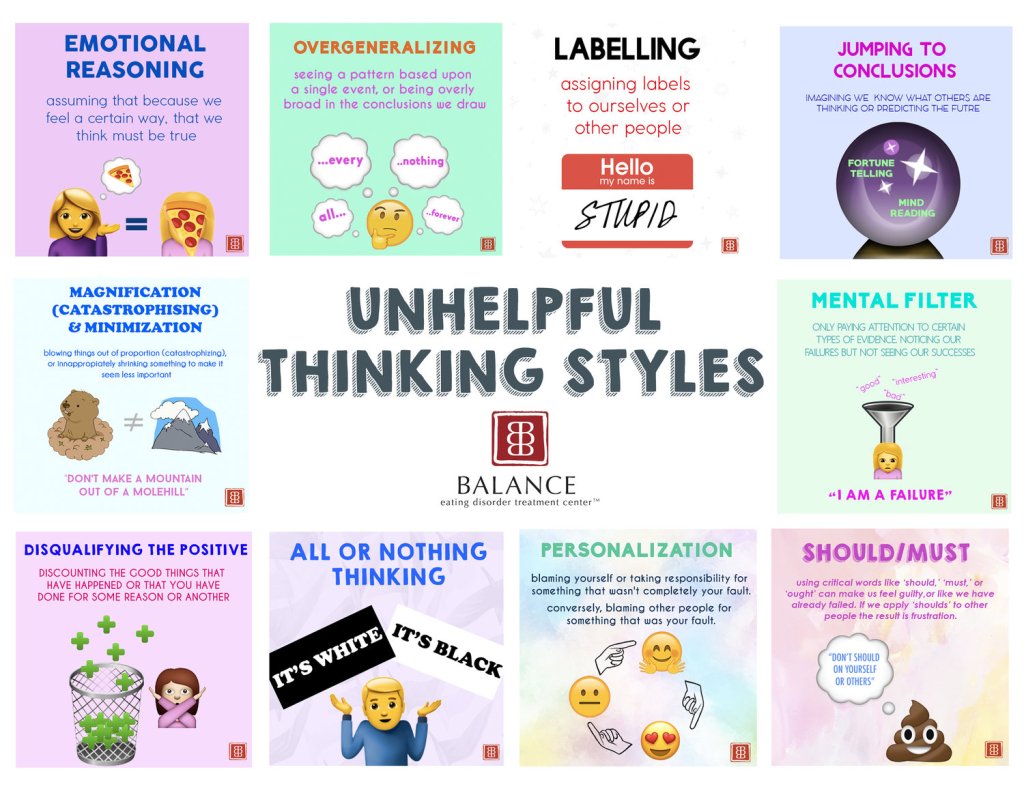
Look at these thinking styles & see if you can identify some of your own thinking styles.
There are, of course, countless ways that anxiety can manifest itself and just as many things that can trigger anxious episodes. The good news is that this kind of unhelpful anxiety is learned behaviour and because of that, we can learn new responses to triggers and bring our anxiety back to healthy, more manageable levels.
Treatments can include medical supports and I would certainly encourage anyone experiencing physical symptoms to explore those with their Doctor to rule out any physiological issues. Talking therapies are also very effective and can address both the symptoms & the root causes of dysfunctional anxiety while working to improve your resilience in facing future anxieties.
So what can you do to help?
Here are my tips:
- Immediate safety is always the number one priority. If you are considering self-harm or feel suicidal then the emergency services should be called as soon as possible.
- Consider getting some professional advice.
- Consult your Doctor and be sure to explore all physical symptoms.
- Consider exploring your experiences with a Counsellor or Psychotherapist. Talking therapies are evidence based and can be really helpful in dealing with the cause as well as helping you develop greater resilience to future stresses.
- Identify & develop your support network. Think who you can call on when needed, who is helpful & in what circumstances. Also consider who is available & when. By drafting this out on paper or digitally, you can refer to it when needed & identify the best possible helper at that time & in those circumstances.
- Connect. Humans grow when they are well connected with others. But, crucially, it’s not about how many friends you have, it’s about the quality & qualities of those relationships. Having a great number of ‘friends’ on facebook is no substitute for being in the company of a close friend.
- Develop a self-care plan. This should include all the things that help you feel better as well as the things that you need for basic functioning. So things like eating a well-balanced diet, attending to personal hygiene, getting enough sleep & rest, and taking regular exercise; It might also include things like your favourite music, TV, film or arts & crafts. Don’t forget to assess your overall lifestyle.
- Slow down. Western societies are obsessed with productivity. Life can feel like a never ending rush to get everything done and tend to all your responsibilities. The chances are that you have more time than you realise and that some of the things you think are important are actually not & serve only to make life harder. Slow things down a bit & learn to engage with what you are doing more mindfully. You will notice things about your experiences that had passed you by before. You will hopefully eventually be able to achieve a fuller experience of life in the present moment and you may also get to know your triggers better so you can develop better responses as well as proactive measures to combat them.
- Put your phone down. Your life is not going to be improved much by endlessly scrolling through the news or social media. In fact, it’s more likely to make you more anxious. Your phone may bring you closer to people far away, but it can also take you far away from the people who are with you.
Of course, there is much more to anxiety than I’ve written about here. We could fill libraries with all the texts written on the subject. I have tried to get across a simple understanding of anxiety, how it can affect us and look at some simple things we can do to help.
If you would like to talk about your mental health, be it about anxiety or some other problem, get in touch with BroadMinds Therapy to see how we can help you.
You can reach us using any of the details below:
Phone: (+353) 0899420568 Web: http://www.broadmindstherapy.org
Email: help@broadmindstherapy.org
Facebook: https://www.facebook.com/jpbroad
As ever, thanks for taking the time to read this.
If you like what you see please remember to like, follow & share to help us reach & help as many people as possible. Take & stay safe.

 Integrative Counselling And Psychotherapy