People experiencing mental health problems can be quite brilliant actors. They are often able to put on a facade that communicates that all is well to others while inside they are in distress. The proverbial duck on the pond springs to mind – All is calm on the surface but below the waterline the duck maybe paddling furiously.

This possibility presents us all with a great challenge: How to spot a friend or loved who may be struggling with depression?
Well, fortunately we know many common risk factors so if you or someone you know has experienced or is experiencing these then we can tune in and pay closer attention.
The risk factors for the development of depression are numerous but we can summarise them into 4 general categories:
The diagram holds a potentially critical insight for us: Any of these categories of risk factors alone is enough to elevate the risk of developing depression. However, where factors accumulate and categories overlap, the risk is greater.
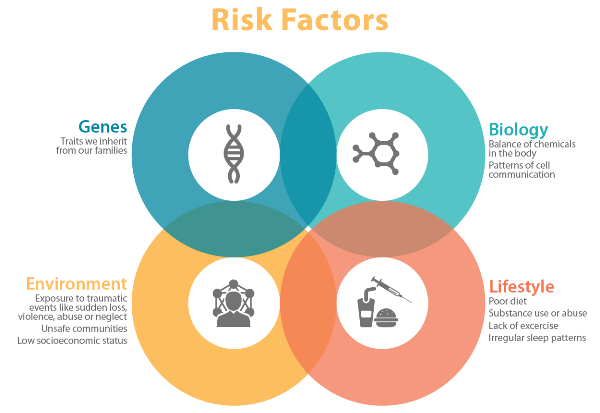
You could look at this & be forgiven for thinking that there is little you can do about your biology or genetic composition. But you might be a little premature in concluding so.
Epigenetics: You have probably heard about genetics but maybe not epigenetics. Genes are the stuff you are born with. The kind of stuff that determines things like your eye colour. However, just to shake things up a little, our genes can be influenced by our behaviours and the environment we’re exposed to. An example of this is the affects of smoking which can cause genetic changes that can result in diseases like lung cancer.
But there is hope! Just as our genes can be triggered into misbehaving by our environment & behaviours like smoking, we can usually choose better environments for ourselves and behave in ways that are more conducive to healthy living. For example, we all know that alcohol & junk food is bad for us. We could simply choose to consume less of them.
You may have noted that I said that we can usually choose better environments for ourselves. I say ‘usually’ because there are many circumstances in which choice is extremely inhibited or impossible. Examples include:
Being a victim of domestic violence.
Living in a hierarchical society or culture in which a person may find themselves subordinated due to sex, race, class, etc, and limited say in life decisions like who they marry, for example.
Being a child – Children can’t choose who they live with, where they live or where they go to school. They can’t choose many of the relationships they have and they have little or no control over the living standards they experience.
Employment – Some people find themselves in very stressful jobs, perhaps even victims of exploitation and have little or no choice in working in the environment they are in.
These are just a few examples of situations in which freedom to make our decisions & choices can be constrained and so, prohibit individuals from taking measures to limit their exposure to adverse environments & conditions.
What can you do to help limit the risk of developing depression?
Well, as ever, I like to keep it simple. Not because depression is easy to resolve or simple to avoid or understand, but because complicated recommendations are less likely to be adopted. In short, if you don’t take the necessary measures for either helping with depression or avoiding it in the first instance, perhaps because the advice is too complicated, then the advice is no good to you or anyone else.
So, think about the following:
Biology & Genes:
I’ve deliberately lumped these two together here because I think for most people, the two will feel like one & the same thing (even though they aren’t). It may well feel to you simply as your physical experience of life.
Consider any family history of mental illness & particularly of depression. Where there is a history, especially where close family relations have struggled with depression, then there is an elevated risk for you. It doesn’t mean you are definitely going to develop it but it is something to be aware of & keep an eye on.
Consider any medications you may be taking as well as any substances that you may be using – legal or otherwise. These can all have side-effects. Find out what they are from reliable sources – Get advice from a healthcare professional.
Lifestyle:
Sleep – Getting good rest & sleeping well is so important. If you are having trouble with sleep I invite you take a look back at our previous articles on sleep as well as discussing these with your GP if you feel you need help with this – There really is no need to struggle on if you’re having sleep issues.
Nutrition – If your diet is poor you can’t reasonably expect your body & mind to function well.
Exercise – The benefits of exercise for both physical & mental health are well documented and understood. Exercise doesn’t have to mean running a marathon. It can be as simple as keeping active whether it’s gardening, walking, or hitting the gym. Just do it & do it regularly.
Work-Life Balance – Is your work-life balance genuinely where it should be? If it’s out of whack, it won’t be long before you follow. Working too hard or all hours takes its toll and you have to ask yourself the very serious question of whether it’s a price worth paying. If you’re not careful, it will effect your health and maybe your relationships, too.
Substance Use – Time to have a frank review of your use of substances including caffeine, alcohol, plus any prescribed & non-prescribed drugs, legal & otherwise, you be taking. It is NEVER a good idea to try to prop yourself up on any of these. If your reliant on any substances to get you through the day (or night) then it’s time to get some help.
Environment:
Home – What do you need from ‘home’? Is it what you need it to be? Is it safe & secure? Does it meet your needs and is it affordable? These are big questions for many people given high property prices & rents. Home may not be giving you what you need but you may feel like you don’t have a lot of choice. Consider getting some professional advice on housing & finance.
Relationships – This leads on nicely to relationships. Consider the health of your relationships and whether they meet your needs. Are they toxic or characterised by aggression, violence, exploitation or manipulation? Don’t just think about your personal relationships – also think about your professional relationships, i.e. work, education, etc. Are these relationships taking more out of you than you get back and if so, is that something you feel you can or even want to sustain?
Employment – Is your employer supportive and do they provide a safe & nourishing place to work? Do you feel that your employer or job is the kind of environment that you can grow in? Are the rewards, whatever form they come in, worth the effort & sacrifice?
Locality – Essentially, where do you live & work? Are you truly happy there? Is it where you want to be and does it meet your needs?
These are just a few examples of the basic questions that you can begin asking yourself to take care of some of those risk factors. I’m essentially suggesting that you play a numbers game – The more risk factors you can take out of the equation the better your odds of improving your mental health and warding off issues like depression.
I’m going to leave it there for now and avoid the temptation to go deeper into the theory – Not because I think you can’t handle the truth (Ahem!). But because I believe that if we keep things simple there is more chance of you adopting these ideas and making a difference to either your own mental health or that of someone close to you… And that’s my role in this. I’m in the helping game.
If you’d like some help with depression or any other mental health issue then please get in touch with us to see how BroadMinds Therapy can help you. You can reach us using any of the following details:
Phone: (+353) 0899420568
Email: help@broadmindstherapy.org
Web: http://www.broadmindstherapy.org
Facebook: (2) BroadMinds | Facebook
Finally, Thanks for taking the time to read this article. If you like what you found please remember to like, follow & share to help us reach & help as many people as possible.

 Integrative Counselling And Psychotherapy