“We are on the verge of becoming a trauma-conscious society”.
Bessel Van Der Kolk: The Body Keeps The Score

This sentence gives me hope when I am filled with dread. It tells of our potential to address one of societies greatest taboos while identifying the bald fact that trauma is occurring on a scale we are blissfully unaware of. If only ignorance was, indeed, bliss.
Research over the last 50 years or so has gradually revealed the significance of trauma in the lives of those whose misfortunes have potentially bestowed upon them a terrible destiny; One that, while escapable, presents a challenge on a scale that is often ruinous to the lives of sufferers. But.. There is hope!
There are three widely recognised categories of trauma:
Complex Trauma which describes the accumulative effect of a repetitive series of events and experiences which usually involve direct harm or endangerment to an individual. These typically involve a specific relationship, period of time or situational setting. An example might be the effect of ongoing abuse of a child.
Post Traumatic Stress Disorder describes the effect on an individual experiencing an extremely distressing event or situation in which the individual was harmed or felt endangered. The individual typically experiences ongoing thoughts and feelings associated with the original event, as if they were still experiencing it.
Developmental Trauma is a fairly new category that describes the experiences of young children during their first 3 years of life. This type of trauma usually develops as a result of abuse, neglect or abandonment. This might come as a surprise to those who hold the often heard false view that if something happens to a child which they won’t remember, it’ll have no effect.
In this post I’ll talk a little more about the circumstances that can result in developmental trauma and later complex trauma & PTSD; Those being the abuse & neglect of children.
For a while this has been a passion of mine. I came to it after doing some research on use & abuse of substances such as alcohol & drugs. The more I immersed myself in the research the more I came to question why people use these substances in the first place given that they are so bad for us. What I came to understand is that all too often these substances are used to try to manage the pain of the past. But that begs the question: What is it in people’s pasts that drives them to turn to these self-defeating coping mechanisms?
I didn’t need to look far. Recent research was already revealing the terrible truth. Although I do not mean to suggest that all addicts & substances abusers have a history of traumatic experience, it became all too clear that this is very often the case.
Bessel Van Der Kolk’s The Body Keeps The Score is a succinct testimony to this idea – A link to which can be found on our Recommendations & Resources page.
Trauma can be identified & measured using an ACE’s survey – An acronym for Adverse Childhood Experiences – which covers 10 types of trauma which we categorise under the umbrella terms of Abuse, Neglect & Dysfunctional Family Environments and considers experiences such as:
- Abuse: Physical, Sexual & Emotional
- Neglect: Physical & Emotional
- Dysfunctional Household: Mental Illness, Domestic Violence, Divorce, Incarcerated Relative, Substance Abuse
It is worth noting that children do not have to necessarily be a direct victim of these trauma factors. Witnessing them is often traumatic, too. An individual scoring 4 or more on this survey will be nearly 5 times as likely to use drugs and over 7 times as likely to develop alcoholism in adulthood; And they are twice as likely to develop diseases like diabetes, heart disease, and cancer. Childhood abuse & neglect is the single most preventable cause of mental illness in adulthood.
Children don’t have the luxury of picking those they grow up around. Of course, they pick their own friends but they don’t get to choose their parents, their relatives, friends of the family… the people they often find themselves in the company of. It’s a terribly sad & frustrating fact that many children find themselves subject to neglectful parenting or even abusive acts that are often deeply traumatic. The idea that because they are young or may not remember much of the detail somehow shields them from the affects should now be resigned to the dustbin forever more.
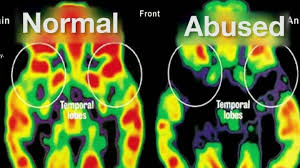
We now know that trauma at any age can have a huge impact on brain function but in children it can also affect brain development to such an extent that it can inhibit their chances of living a normal life. The pre-frontal cortex – the bit that helps us become the rational beings we like to think we are – can become dysfunctional or develop abnormally as a result of neglect & trauma. This is demonstrated in the brain scan pictures below which compare the brain function of a healthy brain with that of someone with a history of trauma:
This can have drastic consequences for the rest of their lives. As children, victims are more likely to be misdiagnosed with psychiatric illnesses, behavioural disorders, and are generally branded as problem-children. They often grow up without the emotional awareness to recognise their suffering or the emotional literacy to explain it. They are more likely to underachieve in education. When they grow up they are more likely to carry mental illness into adulthood, developing apparently miscellaneous physical illnesses as well as diseases like cancer. They are more likely to develop addictions to substances like alcohol & drugs, and are more likely to become obese. They die younger. Much younger. In fact, studies estimate that unresolved childhood trauma like neglect & abuse impacts longevity in much the same way as if the victim were to smoke 15 cigarettes a day for the rest of their lives.
What’s more, victims are more likely become criminals and develop a distorted perception of danger. As a result they may unwittingly put themselves in vulnerable situations that can result in further abuse. If you were raped as a child you are 33% more likely to be raped again as an adult. They are also more likely to self-harm and attempt suicide. It’s heart braking.
These people literally live a life sentence but few see it. They just see the addict or the criminal; They notice the size of the obese person or the child behaving terribly and judgement soon follows. Very few stop to think about what the story is behind that person.
If we accept that one of, if not the most, important role we have in life is to take care of the most vulnerable and raise the next generation, why do we spend so little time learning about it? I spent countless hours studying Maths, English, Physics and the like at school but no one taught me how to look after myself or how to look after others. Our education in this regard is haphazard. It’s left to the very people who may be doing a very bad job; And so, history is more likely to repeat itself: Van Der Kolk writes: “Trauma breeds trauma; hurt people hurt other people.”
To end on some positives, we can at least say that now we are aware of it we are empowered to do something about it. Although the ACE’s survey predicts outcomes for those with a history of childhood trauma, we also know that their future is written in sand rather than stone and with help & intervention by professionals, we can change the tide to rewrite those futures.
If you would like to discuss your experiences of trauma contact BroadMinds Therapy to see how we can help you. Call 0899420568, email help@broadmindstherapy.org, visit our facebook page http://www.facebook.com/jpbroad or message us via this website.
Finally, if you like what you have read please like & share to help us reach & help as many people as possible,
Thank you for taking the time to read this article.

 Integrative Counselling And Psychotherapy