
We al lead busy lives and at times seem enslaved to the push for ever greater productivity & consumption.
No matter what you do with yourself, most of us feel an ever present pressure to do it better or faster, constantly pushing to narrow the gap between where we are and perfection.
No matter who you are there is a pressure to live up to expectations, whether they are your own or those of others. We should be thinner, fitter, stronger, more feminine or more masculine, or less of both; We should be acutely aware of the expectations of changing social environments and be able to adapt our behaviours accordingly.
Pressure, Pressure, PRESSURE.
And all the while, inside us at some level of consciousness is the pressure to let all this go and just be You, Me, I. Whoever that is, and trust that that should be good enough for anyone in your life who deserves to be so.
With this in mind I am attempting to help you leave all this behind and be the best you. I know that you may not have hours to spend on self-reflection & self-improvement. So the question is, how do we achieve this with the limited time that you have?
If I have one guiding principle it is this: Keep it simple.
Life can be complicated. Let’s not make it anymore complicated unless we really need to. So I’m stripping things right back to basics, at least to begin with, and plan to guide you on a journey through 2022 with the series ‘5 Minute Therapies’. Simple, quick & convenient things that you can do that together have the potential to add up to great effect.
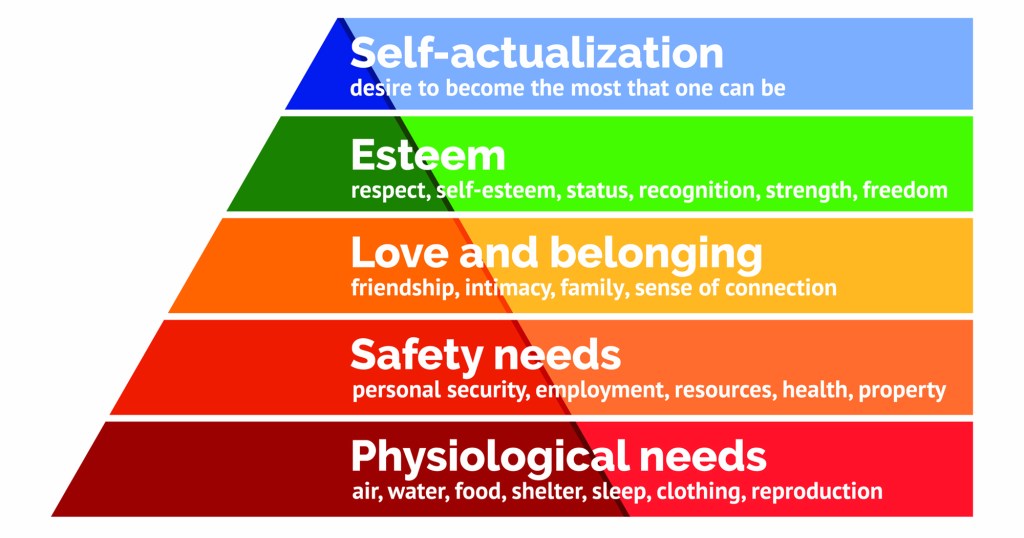
In the this, the first of the series we will begin with a reference to Maslow’s hierarchy. The idea is not without it’s critics but, as a simple model for understanding and organising our mental space, I think it’s useful. The idea is simple: To achieve greater levels of personal growth, we must first address more basic needs. This is summed up below in the following diagram:
So, starting with one of your most basic needs…
Sleep
It never fails to amaze me how many clients I see in practice who have trouble with sleep. And yet, the lack of good quality & an adequate quantity of rest can be so disruptive to our experience of life.
One of the first things I try to determine with clients is how well they sleep. Poor sleep not only leaves them often struggling with the day ahead, but leaves them unprepared emotionally & psychologically to cope with the pressures & stresses they experience, which in turn adversely affects their sleep.
Let’s then, explore some strategies for improving the quality & quantity of your sleep.
Sleep problems are surprisingly common but that will be of little consolation to you at 2:30am when you haven’t had a wink of sleep.
1. Preparing for sleep: A common mistake people make is waiting for the end of the day to prepare for sleep. Actually, our preparation should start at the start of the day. This highlights the importance of routine: It’s likely that your daily routine has been completely messed up by the impact of the coronavirus. If your daytime routine has gone awry it should be no surprise that your ability to rest peacefully at night has been affected. The buzzword of phrase of the moment is ‘the new norm’ which is another way of saying that so much has changed, lately. It’s really important for your sleep to establish a new routine and not simply let the days drift, getting up & retiring at random times, meal times all over the place; And if you’re spending more time sitting around, not actually doing much to engage your body & mind then you may well end up feeling more tired without having really exerted yourself. By all means take the opportunity to get more rest but there’s a balance to be struck between work, rest & play here. Put together a routine that involves rising & retiring at similar times each day; Eat at regular times & don’t get drawn into snacking too much in between meals, particularly late at night. Incorporate your daytime routine into you night time routine.
2. Create a bed time ritual – Think about the things that relax you and integrate them into your sleep strategy. Avoid using computers, phones, tablets, late at night or before going to bed. These devices emit a particular wave length of blue light that can reduce levels of melatonin in your brain. Melatonin helps us sleep, so less melatonin = less satisfactory sleep. If you’re reading your phone in bed, try substituting it for a good book.
3. Diet & Nutrition: Essentially, don’t eat or drink too much, too late. Alcohol – It’s not wine-o’clock! It’s a common misconception that alcohol helps you sleep. Indeed, it can make you drowsy but the quality of sleep you get after drinking alcohol is adversely affected. It decreases the amount of REM sleep you achieve, adversely affecting deeper, more restorative sleep, particularly in the second half of the night. It can also hinder breathing during the night & cause sleep apnea. The more alcohol drank before sleep, the greater the disruption to sleep. Whichever way you look at it, alcohol does not improve sleep. If you’re having issues with sleeping & are self-medicating with alcohol then I advise you to get some professional help with your sleep rather than rely on alcohol which ultimately only makes matters worse. Caffeine – This stimulates the Central nervous system and remains in your system for about 8 hours. It can therefore disrupt your sleep. Consider reducing your caffeine intake as much as possible 8 hours before you intend to go to bed.
4. You are probably spending an awful lot more time at home than you are used to and, because of the restrictions on movement, home can feel more like a cage than the sanctuary. If you have the opportunity to use your 2km zone for safe exercise & you don’t meet the high-risk criteria, then use it. There’s good evidence showing that getting out for some light exercise like walking for about 30 minutes by 9:30am in daylight helps sleep later that day; And the effects are boosted if you can get out in natural settings where there is plenty of greenery like a park, meadow or wooded area. However, it’s important to stress the importance of personal safety. If you are high risk or anxious about exercise in public because of COVID19, use your garden if you have one. Above all, take care & stay safe.
5. Try not to sleep during the day: A nap of around 20 minutes is as much as you should need. Anymore than that & you could be affecting your ability to achieve satisfactory sleep at night.
6. Think about the bedroom environment. Is it too warm, too cold, too light or too noisy? These all have the capacity to disrupt your sleep so if you’re finding that your sleep is being affected by environmental factors then consider how to reduce their effect. Additionally, consider when & how you use your bedroom. If you are using your bedroom throughout the day & for reasons other than sleep & intimacy then the distinction of that environment for sleep in your mind becomes less clear. In short, the more time you use the bedroom for reasons other than sleep, the less you associate it with sleep. Try to avoid using it for other reasons.
7. Consider your stress levels. If you’re finding things stressful at the moment you may well find your sleep affected. See the BroadMinds facebook page for posts in January 2020 for tips on how to manage stress & anxiety.
If you are finding sleeping difficult get in touch for a free consultation and see how BroadMinds can help you. You can reach us on 0899420568, email help@broadmindstherapy.org or message via this page. You can also find out more & contact us via our Facebook page: https://www.facebook.com/jpbroad
Your messages with be deal with discretely, privately & in complete confidence.
If you like what you read please like & share to help us reach & help as many people as possible.
Finally, take care & stay safe. Thanks for reading!

 Integrative Counselling And Psychotherapy
1 thought on “5 Minute Therapy #1: Sleep”