
“I feel a bit depressed today..” What does this actually mean?
Globally, the World Health Organisation state that 264 Million people are currently suffering with depression and consider depression to be a leading cause of disability.
In Ireland, around 450,000 people are thought to be suffering with depression, roughly 1 in 10 people.
In the UK it’s common to chart cases of depression with anxiety because the two are so often linked. Considering it in this way, around 1 in 6 people have symptoms of depression.
It’s quite common to hear people describe themselves as being depressed, or ‘a bit depressed’ and the question is ‘What do we understand this to mean?
Depression, in the clinical (with a small ‘c’) sense, describes a potentially life changing – potentially life threatening – mental illness. The waters are muddied because the term has entered the general public lexicon and is often used freely & interchangeably to mean anything from feeling flat or as experiencing low mood to full on chronic depression, or major depression as it is often now called.
So, first up, let’s just say that there is a stark contrast between feeling a bit flat or low & having depression. But it does seem clear that there is a spectrum along which you must identify your place at any moment in time, between good health & life changing illness.
So, to be clear… What is depression?
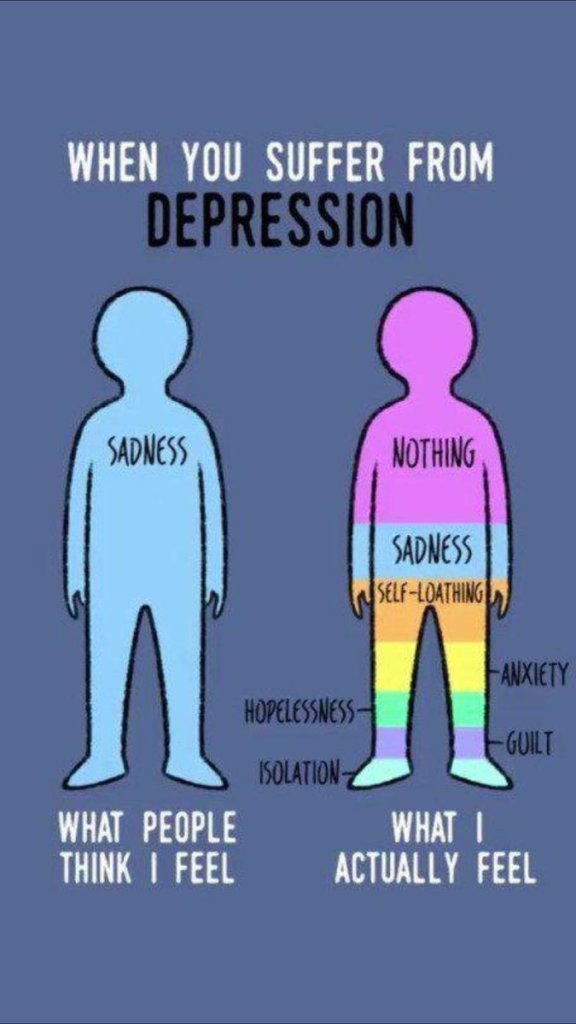
Well, you’ll note that the spectrum I mentioned above didn’t identify the extremes as Utter Despair & Sadness to Euphoria. There are several reasons for this but suffice to say that depression is much more than feeling a sense of despair or sadness, and it’s polar opposite isn’t happiness.
You will have noted from your own experience that it is quite possible to not suffer with depression and experience despair & sadness. The depression sufferers among you may also have experienced periods of happiness during their sufferance.
However, things are complicated a little because feeling sad or despairing can be symptoms of depression which may well be where the confusion lies among the general public.
These are the common symptoms – categorised by their type:
Physical Symptoms:
- Headaches
- Stomach aches
- Other miscellaneous and inexplicable aches & pains that have no physiological cause
- Fatigue
- Low or loss of energy
- A change in eating patterns – either eating more or less than usual
- Disrupted sleep patterns – sleeping too much or not being able to sleep well
Behavioural Symptoms:
- A reduction of enjoyment of activities you previously took pleasure from
- Reduced interest in activities
- Reduced memory, ability to concentrate or ability
- Reduced decision making abilities, greater than experienced before
- Neglecting responsibilities
- Neglecting personal appearance &/or hygiene
Emotional & Cognitive
- A sense of apathy, greater irritability, pessimism, hopelessness, negativity, guilt &/or shame
- Suicidal ideation
- Feelings of low self-worth & self-esteem
- Feeling like there is little point in living
Diagnosis involves assessing the number of symptoms experienced by the individual, their degree of influence and the amount of time these have been experienced for. The symptoms experienced must have been ongoing for a period of at least 2 weeks for a formal diagnosis of depression.
So what causes depression?
The story of depression is a ‘who done it?”. In trying to answer the question – What causes depression, the Detectives have to confess & say that we don’t know for sure… though we have some good leads.
Since the early days of psychology various models of the psyche have been proposed that explain how mental illness can develop ranging from conflicting states or parts of the personality, through to looking at how our experiences in life can influence the mind and form belief systems and thought patterns that determine how we interpret the world around us.
Depression that is influenced or caused by life circumstances & experiences is sometimes called exogenous depression.
Although many of these psychological models & theories have been put to great use in treating mental illness, these theories sometimes conflict with each other and leave us in a position where, despite their uses, we are forced to concede that they can’t all be right in their interpretation of the human experience.
So what about medicines? An unexpected side-effect of a drug used to treat tuberculosis patients in the 1950’s offered some insight into a potential lead. Patients reported feeling uplifted after taking a course of the medication which, as a side-effect, altered how their brains release & reabsorb serotonin. It didn’t take long for Doctors to put 2 & 2 together and come up with, well something like 4. I say that because, although this eventually lead to the development of SSRI’s like Sertraline/Lustral – today, a commonly prescribed anti-depressant – If treating depression is as simple as playing around with serotonin levels in the brain you could be forgiven for thinking that depression’s days are numbered, case closed, right..?
This would lend weight to the idea that depression is caused by some internal dysfunction or defect such as a chemical imbalance in the brain. This is sometimes called endogenous depression.
Unfortunately that’s not always the case – and there are some serious challenges to this idea. If serotonin processing is the problem, why doesn’t the medicine help everyone? Although SSRIs (Selective Serotonin Reuptake Inhibitors) have helped many people, they are not the answer for everyone.
Indeed, for many, successful treatment includes a blend of techniques & strategies such as undertaking counselling & psychotherapy as well as using medicinal supports like SSRI’s.
Please note that treatments don’t include:
- Snapping out of it
- Just being more positive
- Pulling up your socks or keeping your chin up
- Getting yourself together
- Stopping whingeing
- Stop being lazy
- Realising that others have got it worse than you
It fills me incredulity to hear people offer these pearls of wisdom to sufferers. Nothing underlines the level of ignorance in society about depression & mental illness more than such judgements that are often freely given to sufferers. I worry for the people who believe these ideas because, should they ever truly suffer from depression, they will be forced to confront the utter uselessness and misunderstanding of their own beliefs.
That’s a very brief explanation of depression. There’s so much more to say about this illness but to summarise, let’s agree that it is not simply about feeling sad or low at any one moment in time.
I will have more on depression throughout June so watch this space.
In the meantime, if you would like to talk about depression feel free to get in touch with us using any of the the following contact details:
Phone: (+353) 0899420568
Email: help@broadmindstherapy.org
Web: http://www.broadmindstherapy.org
Facebook: BroadMinds | Facebook
Thanks for taking the time to read this article. If you like what you see please remember to follow, like & share to help us reach & help as many people as possible.
Take care & stay safe.

 Integrative Counselling And Psychotherapy