

You may hear people say “I’m a little bit OCD like that.” At best, this a complete misunderstanding of what OCD is and, at worst, belittles the experience of people who struggle with this extremely challenging anxiety disorder. OCD can completely interrupt your ability to function normally. It is not about feeling irritated because the house is a bit untidy.
OCD is an anxiety disorder which can develop in much the same way as other experiences of anxiety, with a vicious cycle involving an obsessive thought giving rise to anxiety which compels the sufferer to behave in ways to relieve the distress followed by a period of temporary relief before the cycle starts again:

The thoughts that drive anxiety & behaviours may or may not be logically related to the perception of danger.
Sometimes the thoughts have a logical component like: I must check I turned the gas off on the stove – which has a logical safety component to it but can become a distorted cognition if you feel like you need to compulsively check that you did so over & over again.
Illogical examples include distorted cognitions such as: If I don’t touch each step of the staircase 13 times my family will die. The sufferer often knows that such thoughts make no sense at all but their experience of anxiety is such that they never the less feel compelled to act upon their fears.
The sufferer thus may a sense of futility, trapped by their obsessions & compulsive behaviours if they are to relieve their experience of anxiety and this can lead to depression:

There is no official categorisation of types of OCD but some identify numerous groups – the first four of the following get a mention in the Diagnostic & Statistical Manual:
- Contamination & cleaning
- Ordering
- Taboo, forbidden or harmful behaviours & impulses
- Hoarding
- Non-visible compulsions
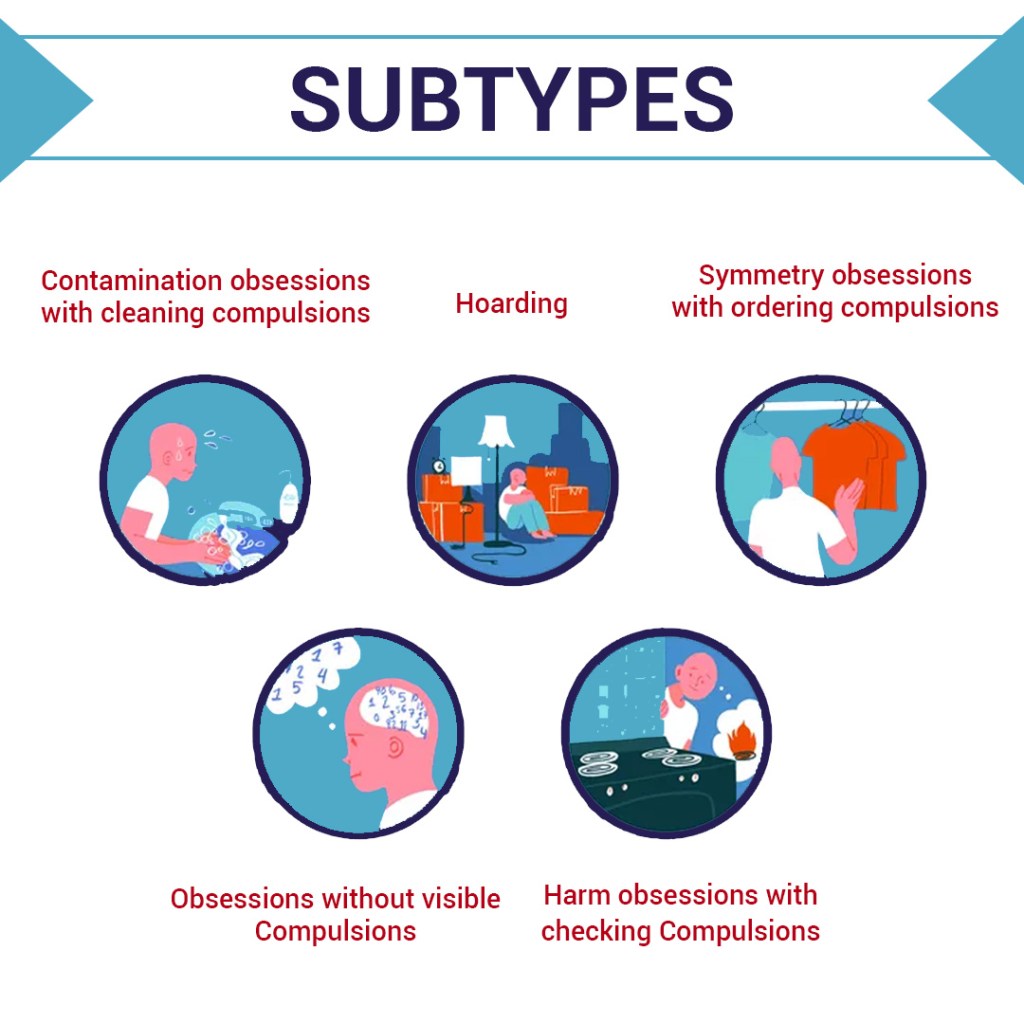
You may have noted that a common manifestation of OCD is excessive cleaning and fear of dirt & germs in the first group. Imagine what it must be like for someone at the moment, in the middle of a pandemic with such a fear when warnings about transmission of disease are everywhere & constantly being reinforced.
Typical cross-group symptoms include:
- Obsession – An overwhelming thought or series of thoughts that dominate the mind.
- Anxiety – A thought or thoughts generate great anxiety.
- Compulsion – A set of behaviours that must be completed to alleviate the anxiety & distress.
- Temporary Relief – The anxiety & distress experienced are only temporarily relived by the behaviours aimed at easing the overwhelming thoughts, anxiety & distress.
Specific group-type symptoms include:
Contamination & Cleaning:
- Persistent worries about germs & illness
- Thoughts about cleanliness or feeling unclean
- Fears about exposure to blood, toxins, viruses, etc.
- Avoiding possible sources of contamination
- Feeling compelled to dispose of ‘dirty’ items, even when clean
- Feeling compelled to clean items considered to be contaminated or unclean
- Ritualistic cleaning
Ordering & Symmetry:
- a need for items or belongings to be aligned in a certain way
- an extreme need for symmetry or organization in items
- a need for symmetry in actions (if you scratch your left knee, you also must scratch your right knee)
- a compulsion to arrange your belongings or other items until they feel “just right”
- feeling incomplete when items aren’t exact
- counting rituals, such as needing to count to a specific number a certain number of times
- magical thinking, or believing something bad will happen if you don’t arrange or organize things in the right way
- organization rituals or specific ways of aligning objects
Taboo & Forbidden Thoughts:
- frequent intrusive thoughts that are often sexual or violent in nature
- guilt, shame, and other distress about your thoughts
- persistent questioning of your sexual orientation, desires, or sexual interests
- persistent worry that you’ll act on your intrusive thoughts or that having them makes you a bad person
- frequent worry that you’ll harm yourself or someone else without meaning to
- obsessions about religious ideas that feel blasphemous or wrong
- persistent feelings of responsibility for causing bad things to happen
- compulsions to hide things you could use as a weapon
- seeking reassurance that you won’t act on intrusive thoughts
- seeking reassurance that you’re not a bad person
- mental rituals to dispel or cancel out your thoughts
- frequently reviewing your daily activities to make sure you haven’t hurt anyone, whether mentally or physically retracing your steps
Hoarding:
- persistent worry that throwing something away could bring harm to you or someone else
- a need to collect a certain number of items to protect yourself or someone else from harm
- extreme fear of throwing away an important or essential item by accident (such as mail with sensitive or needed information)
- a compulsion to buy multiples of the same item, even when you don’t need that many
- difficulty throwing away things because touching them could cause contamination
- feeling incomplete if you can’t find a possession or accidentally lost or threw it away
- a compulsion to check or review your possessions
OCD can also involve behaviours such as:
- shrugging
- throat-clearing
- blinking
- twitching
These behaviours are thought to help relieve the distress & unwanted thoughts & obsessions that sufferers can feel. This type is more common in children although it can also affect adults.
A diagnosis of OCD requires an interview based assessment by Psychiatrist who will consider factors such as:
- The number of recognised symptoms the sufferer is experiencing
- The behaviours & tics experienced
- How much time is spent a day addressing the obsessions & compulsions experienced
- How much your daily functioning & responsibilities are disrupted
Typical treatments for OCD can include medicinal supports as well as talking therapies including practices such as Cognitive Behavioural Therapy which can be very effective.
So hopefully you can see why I thought it necessary to make room this month to discuss this type of anxiety disorder. Amid a pandemic I think it’s easy to see why & how sufferers may be finding this period of history particularly difficult: If you are driven to behave compulsively for fear of contamination, transmission of a virus or inadvertently causing someone harm by some completely unrelated behaviour, this would indeed be a very challenging time.
On the other hand, perhaps the OCD sufferer laments the re-opening of society – perhaps they have never felt so safe as they have done in lockdown.
If you would like to talk about coping with OCD, whether it be for yourself or someone you know, feel free to contact BroadMinds Therapy for help & advice. We offer a free consultation with no obligation to book further sessions. So what have you got to lose? Call (+353) 0899420568, email help@broadmindstherapy.org , message us via this website, or visit our facebook page http://www.facebook,com/jpbroad for more information.
Finally, if you like what you read please like & share to help us reach & help as many people as possible.
Thanks for taking the time to read this article.

 Integrative Counselling And Psychotherapy