
As society begins to open back up and our hopes of a return to something of the life we used to know this is surely a time for hope & celebration. But as we begin to enjoy our regained freedoms we also face some new & old challenges. So, let’s have a look at these briefly before we explore some of them in more depth as the month unfolds – You will probably note that there is a lot of cross over across these experiences:
Grief & Bereavement: The last year or so has been a period of great change & loss for many of us. We’ve lost loved ones, lost freedoms, lost income and maybe lost businesses & homes. I recently published a month long series of posts on Grief & Bereavement in March 2021. I invite you to take a look at those articles for a more in-depth account. In the meantime, here are some of the common experiences of those grieving:
- Anger
- Anxiety
- Guilt
- Shock
- Sadness
- Loneliness
This list is by no means exhaustive and there are a great many physical symptoms and behaviours that are affected by loss. For more information on those and how we can cope with grief, please see our articles published in March.
Depression: Many of us will have spent a lot of time on our own or with a very narrow social circle over the past 15 months. Our relationships have been tested to the limit and along with them, one of our best coping measures. Many clients have reported that they have struggled with the constant barrage of negative Coronavirus related news. Depression, however, is more than simply finding yourself in challenging circumstances. Although these can bring our mood down, depression is a far more pervasive experience. Here’s what to look out for:
- A prolonged sense of profound sadness
- Feeling a loss of hope
- Worthlessness
- Anxiety
- A change in the pleasure you take from things you used to enjoy
- Changes in eating habits
- Sleep disruption
- Struggling to remember things &/or concentrate
- Lethargy
- Fatigue
- Self-harm &/or suicidal ideation
Again, this is not an exhaustive list and I will explore depression in greater depth later this month and in greater depth still, later in the year.
Anxiety: I have deliberately listed Anxiety alongside depression because the two often accompany each other and one can have a great influence on the other. Anxiety is actually a healthy human experience and for the most part, serves to protect us from perceived dangers. However, anxieties can develop about mundane every day experiences that present little or no danger. Spiders are a classic example of this – a very common phobia and yet there is no threat of significant harm from any spider in this part of the world. The list of anxiety related experiences are endless but here are a few of the more common ones:
- Excessive worrying
- Sleep disruption
- Changes in eating habits
- Substance abuse
- Fatigue
- Lack of motivation or excessive activity
- Trouble concentrating or remembering
- Increased heart rate
- Sweating & hot flushes
- Trembling & shaking
- Chest pain
- Feeling terrified
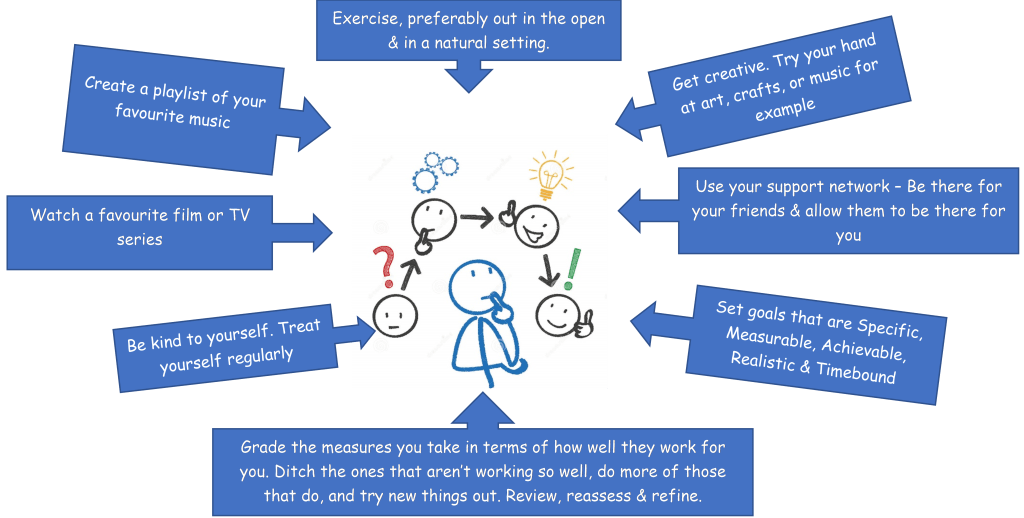
As we take our first few tentative steps back into an open & free society, many of us may well feel anxious about what lies ahead. If you haven’t done so already, now is a good time to think about developing your own coping plan. If you are unsure where to start with this, the following graphic will give you some ideas and set you off in the right direction:
I will look more closely at anxiety later in the month & year.
Self-Harm & Suicidal Ideation: These experiences are again often misunderstood. I often hear people describe an act of self-harm as attention seeking, or a suicide attempt, successful of otherwise, as selfish & cowardly behaviour.
People who self-harm do so in an attempt to cope with suffering & distress that they may find hard to articulate or cope with in other ways. It isn’t all about cutting yourself or harming in yourself in obvious ways. It can also be much more subtle. If you’ve ever reached for a glass of wine, an alcoholic drink of some kind, smoked or taken some kind of drug, you too have self-harmed. Clearly there are behaviours which are potentially more harmful than others but self-harm is as much about the motivation as it is about the specific behaviour.
Thoughts of suicide are surprisingly common and in some sectors of society, it is the leading cause of death. People don’t commit suicide because they are selfish or cowardly. Indeed, for many, they have lived with great courage in coping with life changing illnesses like depression for very long periods of time. It may start to feel like the only option for relief from their illnesses, even if there are other options. If we consider how someone with a life changing physical illness might prefer to be euthanised than live with the circumstances they find themselves in, we can begin to understand suicide a little more clearly.
If you or someone you know is self-harming or suicidal, please reach out to them with compassion rather than judgement. You will need to assess whether the results of self-harm need medical attention – If you are not sure then adopt the policy of better to be safe than sorry and consult a medical professional. If you believe that someone is suicidal then the recommended action is clear – call the emergency services immediately. The warning signs are as follows:
- Believing you are a burden
- Isolation
- Increased anxiety
- Feeling trapped
- Experiencing unbearable pain, physical, psychological or emotional
- Substance use
- Wanting to die
- Planning suicide
- Increased anger or rage
- Extreme moods swings
- Hopelessness
- Disrupted sleep or change in patterns of..
Obsessive Compulsive Disorder: You may hear people say “I’m a little bit OCD like that.” At best, this a complete misunderstanding of what OCD is and, at worst, belittles the experience of people who struggle with this extremely challenging anxiety disorder. OCD can completely interrupt your ability to function normally. It is not about feeling irritated because the house is a bit untidy.
A common manifestation of OCD is excessive cleaning and fear of dirt & germs. Imagine what it must be like for someone at the moment with such a fear when warnings about transmission of disease are everywhere & constantly being reinforced.
Typical symptoms include:
- Obsession – An overwhelming thought or series of thoughts that dominate the mind.
- Anxiety – A thought or thoughts generate great anxiety.
- Compulsion – A set of behaviours that must be completed to alleviate the anxiety & distress.
- Temporary Relief – The anxiety & distress experienced are only temporarily relived by the behaviours aimed at easing the overwhelming thoughts, anxiety & distress.
I will look more closely at the legacy of the lockdown in the month ahead so stay tuned for more information.
All of these experiences can be helped, supported & treated with access to talking therapies and medical interventions. All of which start with talking to someone, so please reach out if you need or want help, and look out for each other. If you experience any physical symptoms at all it’s always a good idea to get them checked out by a medical professional.
If you would like to talk about these or any other mental health issue BroadMinds Therapy will be happy to help. You can reach using any of the following contact details:
Phone: (+353) 0899420568
Web: http://www.broadmindstherapy.org
Email: help@broadmindstherapy.org
Facebook: BroadMinds | Facebook
As always, thanks very much for taking the time to read this. If you like what you see then please remember to like, follow & share to help us reach & help as many people as possible.
Take care & stay safe.

 Integrative Counselling And Psychotherapy