
So far we’ve considered grief as a process of detachment from that which we have lost. We may be told we need to move on and people try to reassure us that time will heal our wounds, that somehow the passing of time will gradually make things easier for us.
Perhaps they are right. I’m sure that for some, they are. But.. this isn’t the case for everyone and, in any case, the passage of time itself can be a very painful period.
These basic ‘common sense’ approaches appear to contain some wisdom. These ideas have been passed down from one generation to the next and the fact that they have survived throughout the ages seems to give them the status of useful knowledge.
So let’s look at these ideas a little closer and see if there is anything there that we can actually use in helping with our grief:
What does moving on actually mean? There are some implicit connotations in this idea and they are not always very helpful in coping with grief.
What happens next for you? The idea that after losing someone you have to face the next moment, day, week, etc.. without them in your life in the way they once were is certainly true. This implication could also be extended to the idea that we ‘should’ embrace the future but crucially, this is easier said than done.
A little tip here – Whenever you catch yourself or someone else using ‘shoulds’, it’s time to put the brakes on and change that ‘should’ to a ‘could’. Give yourself options with ‘coulds’, not obligations with ‘shoulds’.
- Overcoming the pain, distress & suffering evoked by loss. This is the idea that we need to live on & relieve ourselves from the deepest of our grief related pain & distress. It can be summed up by the phrase ‘Getting on with things’. It almost implies that overcoming grief is something we can achieve simply by making the decision to overcome it. The problem is that if things were that simple, grief wouldn’t be as difficult as it is for some of us to overcome and the idea that we can decide our way out of things may carry with it a pressure for our grieving to progress within a certain timescale or in some socially accepted way; Neither of which may be particularly helpful.
- Moving on or detaching is one way that we’ve defined the grief process, but this doesn’t necessarily mean becoming disconnected with those we have lost. Connections exist in all kinds of ways from the genes we inherit & share with family and the influences we have on each other throughout the time & space we have shared in life, to the memories we have of each other, the photographs & videos we have made, and the material things we have in life from homes and possessions such as clothing and other physical items.
- Leaving the past behind. Is this something we can ever really achieve? Are we not in the present, at least in part the sum of our history? Even if we are able to forget the past, forgive tresspasses, etc, we cannot willingly delete the influences of our experiences that have contributed to what we have become. Even if we spend little conscious effort considering our experiences in life, it’s hard to see how we can completely eliminate any influence they have had on us; And, in many cases, we wouldn’t want to anyway. When we lose loved ones, we often desire to carry them with us in our hearts & minds. On the flip side of that coin, it’s easy to see why some people might want to leave the past well behind them if it has been unhappy. But even in these cases, the total elimination of influence of experience would seem to be a lofty goal – The very desire to leave that unhappy period or person behind is itself influenced by the negative experience. We can minimise it & learn to cope better but it’s unrealistic to think we can simply leave the past behind us and move on having not been affected by it.
And, how can the passage of time help exactly?
- Time’s a healer. This a commonly held view and it’s not without merit. For some people the passing of time does help with our experience of grief. Time provides the opportunity process our thoughts & feelings and reorient ourselves in life following a loss. It offers an opportunity to use our potential, our personal resources to navigate a new way in life. But I guess I would say that time can be a healer but it doesn’t come with a guarantee. We have to use the resources we have available to us to unlock our potential and adapt to life as time goes on. Time isn’t enough on its own, we must also use it well.
- Spacetime.. Not strictly in the Einsteinian sense but this is the idea that space & time are the same thing: That the passing of time comes with a passing of space that we once shared with someone. That vacant time & space offers a message to us as we pass through it. That being that, this space & time once shared is now our own. That can come with all sorts of feelings be they positive or negative but the passage of time and space & constant reinforcement of that message can make it feel all the more real; It is something to which we have the potential to adapt to.
In sum, let’s not throw the baby out with that bath water here. Yes, there is something to be said for the generational ideas about moving on & time being a great healer, but the inference that this is all there is to overcoming grief doesn’t really cut it for most of us.
In therapy, for clients who are struggling with grief after having lost someone important to them, I often use what’s called the third chair technique. This is essentially a role play exercise in which I invite the client to imagine that the deceased is sat in the room with us & say what ever they wish to say to them. Sometimes I’ll take it a stage further & invite them to play the role of the deceased and give them the chance to respond.
Some clients find this a cathartic experience and for those that do I invite them to put this technique to good use in other areas of their life when they feel that the support of those they have lost is desirable. For example, imagine you have a unsettling medical procedure coming up and you wish you had the support of a parent you have lost. You could write that parent a letter explaining what you feel you need from them to help you through the experience and keep that letter with you on the day. You may even choose to write a letter from them back to yourself.
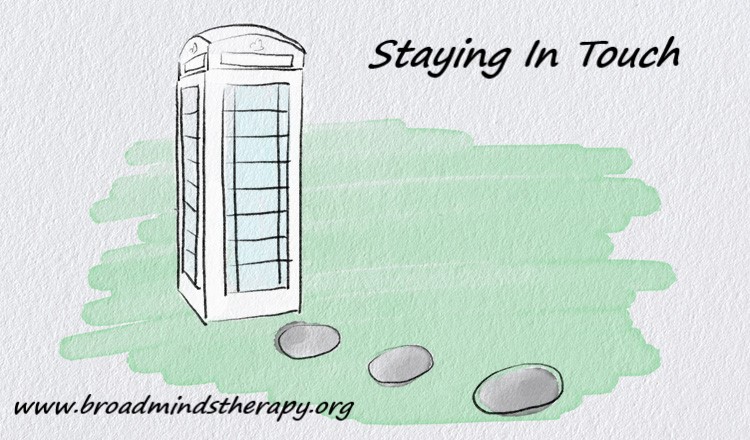
Another idea is to keep an old mobile phone which is no longer connected to the network. Whenever you want to talk to someone you have lost you simply use that phone to say what you want to that person.
I have used this kind of exercise many times in the past with clients and they often report back saying how helpful & comforting they have found this approach.
It is a way of demonstrating that death & loss can be considered a transformation of the relationship that you have with someone rather than an end to it; And a way to preserve a connection, if you so desire it.
Key Take-Aways Then:
- The old ages about moving on & time being a great healer are not without merit but there is much more to grief than that.
- Your experience of grief & loss is yours and unique although there are common themes & types of experiences.
- Death can be seen as a transformation of the relationship you once had and there are ways to preserve your connections if you so desire, using methods as described above.
If you would like to talk about your experience of grief or any other mental health issue you can reach us using any of the following methods:
Web: http://www.broadmindstherapy.org
Email: help@broadmindstherapy.org
Phone: (+353) 0899420568
Or find us on social media at http://www.facebook.com/jpbroad
Finally, thanks for taking the time to read this article. If you like what you read please like & share to help us reach & help as many people as possible.

 Integrative Counselling And Psychotherapy