
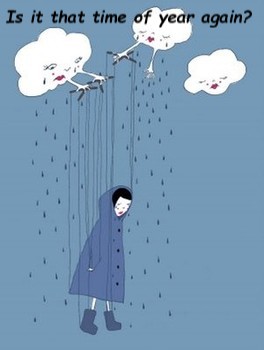
When it’s dark outside, it can be dark inside. It can be quite a comforting experience to light the fires and curl up inside while watching Mother Nature do her worst outside your window. But for some, the Autumn & Winter months of the year can feel very long indeed. Sometimes called The Winter Blues, Seasonal Affective Disorder affects 6.7% of people in Ireland & 3% of the population in the UK.
While we take shelter from the cold and try to stay safe & warm the amount of sunlight we get drops and this can affect the levels of serotonin released by the brain. Serotonin is the happy hormone, so the basic theory goes that Less Sunlight = Less Serotonin = Less Happiness.
Seasonal Affective Disorder (SAD) is characterised by a depression with symptoms that worsen during certain times of the year, usually during with the Autumn & Winter seasons and improve throughout the Spring into the Summer, but this can vary for each individual.
The severity of symptoms also varies from person to person with some experiencing only mild depression while for others it can have significant implications for routine life.
Typical symptoms include:
- Persistent Low Mood
- Lack or loss of pleasure in normal regular activities
- Irritability
- Despair
- Guilt
- Worthlessness
- Low Self-esteem
- Tearfulness
- Elevated stress levels
- Reduced libido
- Withdrawing from social life
- Fatigue
- Lethargy
- Disrupted sleep cycles & patterns
- Decreased ability to concentrate or remember things
- Increased appetite
These symptoms can be interrupted by periods of happiness, increased energy and sociability, sometimes described as ‘manic’ episodes which confuse some into thinking that their experience is something other than a type of depression.
A psychological assessment which considers your moods, lifestyle, eating behaviours, sleep patterns, seasonal changes in thoughts & behaviours, impact of symptoms on daily life, and history of mental illness in your family, can be conducted to determine a formal diagnosis. Diagnosis can be complicated given that the typical symptoms of SAD are also symptoms of other types of depression but in general, diagnosis usually rests on the seasonal nature of your depressive experience, feeling depressed for long periods followed by long periods with greatly reduced depression, and a cycle of these experiences lasting for 2 years or more.
SAD is a treatable illness, treated in much the same way as other types of depression and can include a combination of medicinal treatments as well as talking therapies. Your GP should help identify the best treatment options for you.
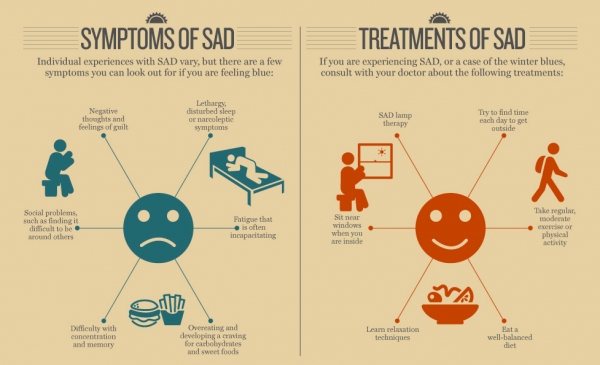
If you think you may have SAD I urge you to seek professional help starting with your GP and then a Counsellor or Psychotherapist. There is help available for sufferers and there is absolutely no need for you suffer alone. While you are waiting for help there are some things you can try yourself that may help relieve the symptoms, which include the following:
- Start keeping a journal. Not only will this give you an opportunity to express your thoughts and feelings but it also gives you an opportunity to record your experiences over time. This can help when you seek professional help because you will already have a record of your experiences. Include information on your diet & nutrition, sleep patterns, as well as your own assessment of your levels of depression & stress on any given day. It doesn’t need to be a daily essay – You can write as little or as much as you like. A few minutes every day to make a few notes is a good place to start.
- Get out in the daylight. There is evidence that shows that the reduced amount of daylight & sunshine we usually experience during the Autumn & Winter months is a factor in SAD. So, take the opportunities that present themselves to get out in the daylight. Even on the brightest days, when you are sat inside your home or a car you only get around 1/6 of the daylight you get when your outside so get up & get out.
- When you are inside, sit near windows if you can. Every little helps!
- Exercise. Take regular daily exercise, preferably out in the daylight. This doesn’t have to be running a marathon or competing in the local triathlon. It can be a walk, a cycle, some gardening. Try a few things out & see what works for you & if you find yourself struggling with motivation, apply the 2 minute rule: Try it for 2 minutes. If you really can’t carry on then at least you’ve done something for 2 minutes, but usually it’s the getting started that’s the real obstacle and once you’re up & going, you’re more likely to carry on.
- Eat a healthy & well-balanced diet. Your nutritional habits affect the way you think & feel.
- Take steps to manage exposure to stress. You can find plenty of tips on this in previous blog posts or on our facebook page – the link is below.
If you would like to talk about depression or Seasonal Affective Disorder feel free to contact BroadMinds Therapy for help & advice. We offer a free consultation with no obligation to book further sessions. Call (+353) 0899420568, email help@broadmindstherapy.org , message us via this website, or visit our facebook page http://www.facebook.com/jpbroad for more information.
Finally, if you like what you read please like & share to help us reach & help as many people as possible.
Thanks for taking the time to read this article.

 Integrative Counselling And Psychotherapy