
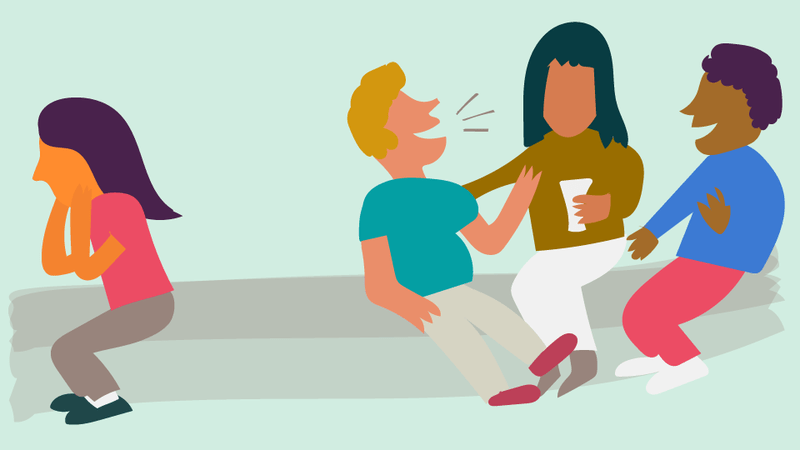
We live in a strange paradox. A world that often places great value on extraversion, sociability, and popularity and yet, surprisingly, 13% of the population experience social anxiety and that figure is rising year-on-year. So, what is going on here? Why do we value these qualities in people when more than 1 in 8 of use struggle in social situations?
Let’s start with the basics…
What is Social Anxiety?
Social Anxiety is much more than being shy or a little nervous in social situations. If we look back to our previous posts on anxiety: Anxiety is a normal human experience which serves to protect us when we perceive danger. It’s the thing that made us freeze, fight or run when Sabre Toothed Tigers were jumping out of bushes looking hungry. Thankfully, or sadly, depending on which way you look at it, there aren’t too many of them around anymore but there are other dangers around like moving traffic, for example. Anxiety is the thing that makes your heart race or skip a beat when you step off the kerb but realise at the last split second that there’s a car coming & it would be a really bad idea to continue walking in that direction.
We can think of anxiety as falling into two types:
- Intrinsic (Nature) – That which we are born with.
- Learned (Nurture) – The things we learn to be anxious about during life.
Intrinsic anxiety can be seen if you make a sudden loud noise near a baby. They will usually startle and begin to cry – Please don’t try this at home.
Learned anxiety relates to the things we develop fears about as we grow & mature. We aren’t born with phobias. We learn them. For example, a common fear is that of spiders. However, spiders rarely present any real danger to humans but we usually develop these anxieties as a result of the reactions of caregivers (Parents & Guardians) as we grow up. My mother used to jump out of her skin whenever she saw a spider. No coincidence, then, that both of her children also developed the same reaction.
This presents us with an opportunity. If being anxious is something that is learned, we learn to react differently to our triggers. For example, I overcame my reaction to spiders learnt from my mother and I can hold them with no issues at all, now.
Anxiety serves us well, then. It helps keep us safe. But the same brain processes that kick starts our anxiety-based protection mechanisms can begin to work against us and make every day life very difficult.
So what does Social Anxiety look like for you? Here are some of the common symptoms:

Some of these symptoms are very useful. If you are in danger, having a heart that’s racing & pumping blood around your body at a greater rate is just what you need to run away from danger or enable you turn & fight. But if you’re not in genuine danger or if the heightened state of arousal lasts much longer than the dangerous moment, health issues can arise. For example, the stress hormone Cortisol is really useful in the short term but long term exposure can lead to weight gain, high blood pressure, disrupted sleep, depleted energy levels and promote the development of diabetes. Cortisol is a good friend in moments of genuine need but it can certainly outstay its welcome.
People who struggle with social anxiety often become acutely aware of their emotions or physical symptoms when in social situations, fear that their struggle is apparent to those in their company and worry that they will be judged, causing even greater anxiety. It’s a vicious cycle that can quickly run away with itself and leave you feeling overwhelmed.
Back to our question What is social anxiety?
- Confidence: Some people think of social anxiety as manifest in low confidence. It can be a factor, but it’s not the whole story. People are great actors.. It’s possible to be confident but still experience social anxiety. However, more common is the appearance or perception of confidence in others when they are experiencing anxiety. The distorted perception can leave us feeling inadequate by comparison if we feel like we don’t measure up to the examples before us. Our own lack of confidence & low self-worth can create a distorted perception of the confidence of others, leaving us with the impression that we don’t cut it socially; Making us feel even worse. It’s not uncommon to find people relying on self-defeating coping measures like alcohol to help with anxiety in these situations.
- Beliefs & Assumptions: Often, the beliefs & assumptions that we hold dear actually facilitate & nurture our social anxiety. For example, the idea that being sociable & popular somehow adds value to us as human beings. The language we use even supports this idea: It is often said of such people that they are great personalities while others who are perceived as dry, quiet or unwilling to connect with us as being without a personality. It’s only when we stop to look at these beliefs & assumptions that we start to realise how absurd they are: How can someone have no personality? How do these underlying beliefs & assumptions that we have developed over time impact on the way we see & value ourselves?
- Assertiveness: A common experience for those with social anxiety is a sense of inability to say what they are thinking or feel to such an extent that failing to do so can be of great disadvantage to them.
- Social-Phobia: Left undealt with, our social anxieties can worsen to such an extent that we end up avoiding social contact altogether which can impact on our ability to address some of our basic needs. It can impact on our ability to buy groceries, buy clothing, access medical care & medicines, work, access education, not to mention maintain relationships with others. At this stage, social anxiety is severely undermining our ability to meet our basic needs and there can be further adverse consequences for physical & mental health if it is left unaddressed.
- Experience: Social anxieties are usually born of experiences, things that we have learned along our way through life. We may have been mistreated, perhaps abused or neglected, bullied or simply not had the kind of influences in our life that nurture confidence and an ability to connect with others. These can leave us ill-equipped to function socially in a way we desire.
The good news is that these are all things that we can work on & relearn new ways of thinking & feeling. Above all, we can reacquaint us with ourselves, learn to accept & express ourselves as authentically as possible, and learn to love whatever that is.
If you would like to talk about coping with anxiety, whether it be for yourself or someone you know, feel free to contact BroadMinds Therapy for help & advice. We offer a free consultation with no obligation to book further sessions. Call (+353) 0899420568, email help@broadmindstherapy.org , message us via this website, or visit our facebook page http://www.facebook,com/jpbroad for more information.
Finally, if you like what you read please like & share to help us reach & help as many people as possible.
Thanks for taking the time to read this article.

 Integrative Counselling And Psychotherapy