
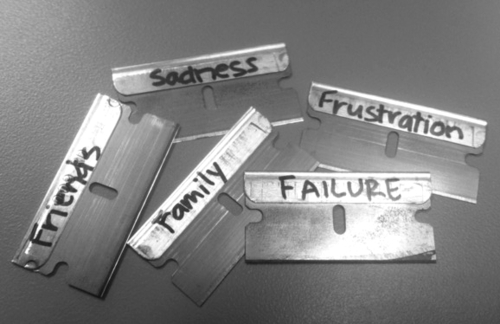
We’ve covered self-harm with children in our previous post. However, self-harm also affects the rest of society.
Research suggests that around 210 out of every 100,000 in Ireland and 400 people out of every 100,000 in the UK self-harm. It is worth noting here though, that numbers of people self-harming are likely much higher. These figures only represent those presenting at medical facilities for assistance with their injuries, where as the majority of self harm incidents aren’t reported at medical facilities.
The number of people self-harming is on the increase, rising by just over 16% since 2002 and the data suggests that those who self-harm are self-harming more with instances rising by around 19% over the same period.
So what’s going on? What is driving more & more people to self-destructive behaviour?
Well, as you might expect, there’s no one answer to this question as the following graphic illustrates. People of different ages and gender tend to self-harm in different ways & at different rates:
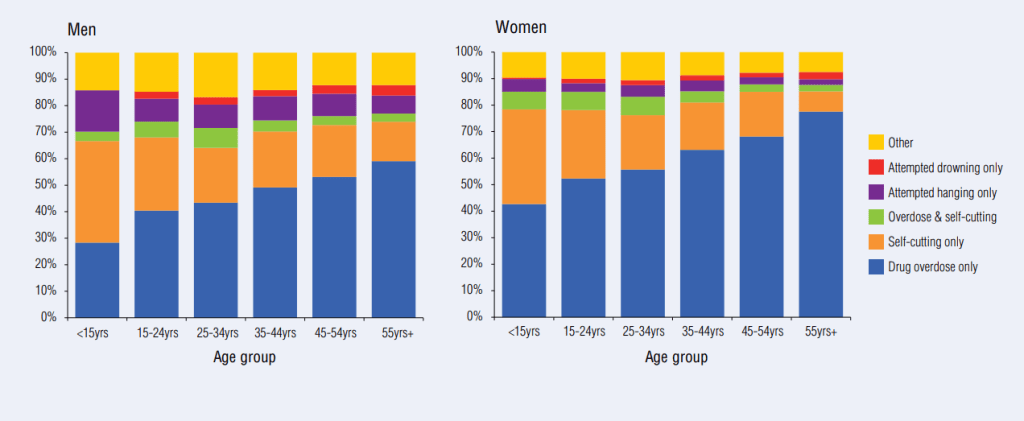
You can see from the charts above that cutting & over-dosing are the most common forms of self-harming across all ages & genders. However, the older you are the more likely over-dosing is to be your method of choice, while the younger you are, the more likely cutting is your method of choice.
This information is more than a point of interest. It can be used to guide us as when considering what we should look out for in each age & gender group. Of course, we need to be mindful of all types of self-harm when looking out for those we love but understanding what self-destructive behaviours people are more likely to turn to gives us a good starting point.
Also, if we consider the reasons why people turn to self-harming as a coping measure, we can take measures to prevent it from happening in the first place. What follows is a list of common reasons people self-harm:
- Work or school based stress
- Bullying or coercion
- Financial problems
- Being a victim of abuse, including physical, verbal & sexual
- Loss & Bereavement
- Confusion over sexuality
- Confusion over sexual identity
- Relationship dysfunction & loss
- Job loss
- Illness & poor health
- Low self-esteem
- Increases in stress levels
- Depression & anxiety
- Feelings of anger & numbness
People who self-harm often do so as a way of masking or displacing the emotional & psychological pain being experienced, for example, by any of the reasons above, with physical pain which they may find more manageable. In this way it is seen as a coping mechanism. Put simply, the self-harmer may be trying to replace one type of pain or distress with another kind that they find easier to cope with.
More common types of self-harm include:
- Overdosing – Including both prescription & non-prescription medications as well as illegal substances
- Substance misuse & abuse
- Cutting
- Burning
- Banging of the head or other body parts against hard objects
- Puncturing the skin
- Swallowing things
- Pulling out hair or eyelashes
- Self-tattooing
- Sadomasochistic practices
- Over-eating or under-eating
- Putting oneself in danger
Clearly this is not an exhaustive list but hopefully it informs & provides a snapshot of what to look out for; And apologies for the repetition from our previous post but this is so important I want to reinforce the kind of behaviours to look out for that might indicate that someone is self-harming – It’s simply too important not to know this:
- Becoming withdrawn.
- Unusual outbursts of frustration &/or anger.
- Changes in mood, particularly persistent low mood.
- Covering Up: Wearing clothes that don’t seem appropriate such as long sleeves on hot days, roll-neck sweaters, or changes in typical clothing choices that mask body parts that are usually visible.
- Signs of anxiety like constant fidgeting, twitching, pacing.
- Obvious signs of self-harm like picking & scratching at skin, pulling hair.
- Changes in eating & drinking habits.
- Changes in exercise levels.
- Accessing self-harming resources
- Peers:
- People are more likely to self-harm if their peers self-harm. Therefore, be mindful of the relationships that your friends & family maintain. If you think that a friend of theirs is self-harming or encouraging that behaviour, it may be time for careful intervention.
- Role Models:
- Again, people are more likely to self-harm if role models are known to self-harm, too, so be mindful of those they look up to.
My advice remains simple & straightforward: Don’t try to cope with this alone. Get professional help.
If you recognise these signs in yourself or someone you know, it’s time to consider getting some professional help. Always remain aware of potential needs for medical assistance. If you or someone you know is suicidal then do not hesitate to contact the emergency services as soon as possible.
If you would like to talk about self-harm, whether it be for yourself or someone you know feel free to contact BroadMinds Therapy for help & advice. Call (+353) 0899420568, email help@broadmindstherapy.org , message us via this website, or visit our facebook page http://www.facebook,com/jpbroad for more information.
Finally, if you like what you read please like & share to help us reach & help as many people as possible.
Thanks for taking the time to read this article.

 Integrative Counselling And Psychotherapy