
Deregulation of the gaming industry, the advent of the internet & and increasing knowledge about the process of developing addiction have resulted in the transformation of the gambling industry in recent years from the dingy high street bookies, still familiar in many areas, to an omnipotent presence. No night in front of the TV is completed without ads appealing to us to part with our money with the message that we can somehow make our lives more interesting by gambling. Go online and you’ll soon find pop ups and ads for online casinos & betting services & products trying to tempt you once more. Where ever you look, it’s there… It’s in the high street, it’s in your home, it’s even in your pocket on your phone.
What’s more, the gambling industry deliberately designs it products & services to keep you coming back for more. In short they know how to cultivate & nurture addictive behaviours so that, for many, the temptation is always on your mind.
Deregulation of the industry & the advent of the internet have given betting companies the perfect platform to deliver the perfect storm.
The stats & facts about gambling in the UK & Ireland are frightening:
- 42% of people in England (excluding only National Lottery stakes) gambled in 2016.
- 7% of people in England identified as problem gamblers.
- 2% of gamblers in England identified as problem gamblers.
- 6% of people in England were at low to moderate risk of developing problems with their gambling.
- Between 250 & 650 gambling addicts commit suicide every year in the UK*.
- Gambling addicts are 15% more likely to commit suicide than members of the general population*.
- Recent changes in legislation in the UK governing maximum bets on FOBT are seen as recognition that some ‘games’ are designed to be deliberately addictive & too dangerous be allowed to operate free from regulation.*
*Source: BBC Radio 5Live – Breakfast show 24th June 2019
In Ireland the picture is similar:
- In 2019 almost €10 Billion was spent on gambling, almost €380 for every person in Ireland.
- Money spent on gambling in Ireland in 2019 rose by approximately 25% on 2018.
- Ireland ranks 7th in the world for money spent on gambling by head of population.
- Irish gamblers lost €2.1 Billion in 2016, with the average gambler losing around €470 each year.
- Estimates suggest that around 80% of all revenues from online betting come from around 4% of customers.
- Gambling revenues generated from gaming machines, bingo & casinos are now bigger than sports betting.
- The Irish Government estimate that there are around 30,000 problem gamblers in Ireland.
- Around two thirds of the Irish population gamble regularly with lottery tickets & scratch cards being the most common form of gambling.
- 10% of 15-17 year olds have gambled purchasing lottery tickets or scratch cards and 15% say they have gambled on horse or dog racing.
Gambling watchdogs identify the following signs as potentially indicative of problem gambling:
- Spending more money and time on gambling than you can afford
- Finding it hard to manage or stop your gambling
- Having arguments with family or friends about money and gambling
- Losing interest in usual activities or hobbies like going out with friends or spending time with family
- Always thinking or talking about gambling
- Lying about your gambling or hiding it from other people
- Chasing losses or gambling to get out of financial trouble.
- Gambling until all of your money is gone
- Borrowing money, selling possessions or not paying bills in order to pay for gambling
- Needing to gamble with larger amounts of money or for a longer time to get the same feeling of excitement or buzz
- Neglecting work, school, family, personal needs or household responsibilities because of gambling
- Feeling anxious, worried, guilty, depressed or irritable
Gambling is often divided into 4 categories:
- Social Gambling: A behaviour shared between friends & associates. Typically, this type is time limited, and potential losses are considered & affordable.
- Professional Gambling: A behaviour in which risks are limited and controlled with discipline, such that losses do not risk financial stability & security.
- Problem Gambling: Gambling behaviours start to preoccupy the mind & the individual starts to become disinterested in other activities. Adverse consequences do not curtail levels of gambling.
- Pathological Gambling: Gambling behaviour characterised by distorted cognitions, defence mechanisms like denial, superstitious beliefs, confidence levels that don’t reflect reality, and a false sense of power & control.
Robert Custer actually identified six types of gambling, adding Relief & Escape gamblers & Antisocial Personality gamblers into the mix, but was the first to identify gambling as a disease or pathological behaviour disorder & was instrumental in persuading the American Psychiatric Association to classify compulsive gambling as a psychological disorder.
Other common characteristics & effects of gambling are as follows:
Symptoms include:
- Euphoria
- Tolerance
- Withdrawal
- Excitement
GamCare succinctly & concisely sum up an increasingly common picture of problematic gambling:
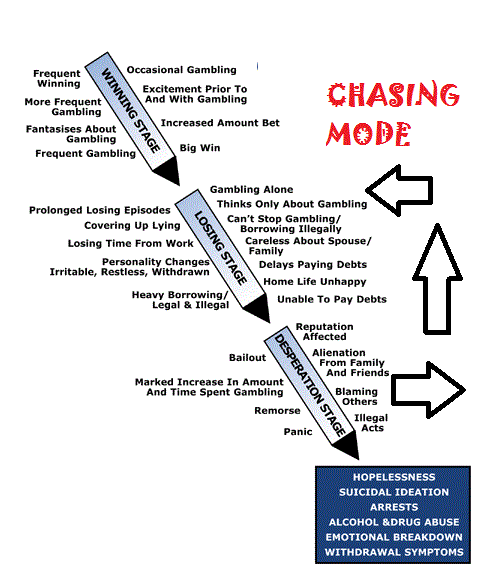
“Gambling problems and financial issues really go hand-in-hand. A financial crisis is often what brings a person to address their gambling. It’s also not uncommon for partners, friends or family members of problem gamblers to tell us that they did not realise their loved one was a problem gambler until there were serious financial consequences such as a court summons for non-payment of debt or repossession action on their home. And financial problems can really mount up. Bills don’t get paid, debts accumulate. If you have credit cards, you might max them out to pay your bills, or worse, to keep gambling. At this point, payday loans may look like a solution – but their high interest rates and charges are likely to make the situation worse. Business-owners can also find themselves in debt due to using business money to finance their gambling.
A common dilemma for someone with a gambling problem is how to get out of debt. For many, the chance to continue gambling in order to win it back and make everything alright again can feel overwhelmingly tempting. It might also feel as though there is no chance of repaying debts accrued through gambling unless you carry on gambling, so you feel completely trapped.”
It’s a cycle that looks like:
http://www.problemgambling.ie report that there is no current governmental spending on treatment for problem gambling in Ireland and that the HSE did not include treatment in it’s 2018 service plan. Estimates for the cost of problem gambling to the Irish Exchequer range from between €21 Million & €98 Million each year. Despite this, thejournal.ie published an article in October 2018 seemingly critical of the government for the raising the tax on betting from 1% to 2%, a move which doubled tax revenues from the gaming industry from €20 Million to €40 Million annually.
In the UK in 2017 Labour MP Tom Watson claimed that problem gambling costs the exchequer between £260 million & £1.2 billion each year. Seen in comparison to the recent push from government for the gambling industry to put together a £10 million annual fund to help combat problem gambling, we see the scale of our current resolutions against the problem the industry creates. In 2018 The Guardian reported that Denise Coates, Chief Executive of Bet365 was paid £323 Million in bonuses, bettering her bonuses of £265 Million in 2017; While the industry as a whole resisted contributing to the £10 Million fund to help deal with problem gambling. I think that puts things into perspective for us & demonstrates where the priorities of the gambling industry lay.
It seems that as a society we are prepared to accept that the gaming industry generates huge profits for itself but is not willing to address the damage that it does. It priorities lie in profit rather than public protection.
The good news is that help is available.
If these problems sound familiar to you and you would like to talk about gambling and mental health please contact BroadMinds Therapy for a free private, discrete and confidential conversation. Phone (+353) 0899420568, email help@broadmindstherapy.org or visit our facebook page https://www.facebook.com/jpbroad
Finally, please remember to like & share so we can reach & help as many people as possible.
Thanks for reading!

 Integrative Counselling And Psychotherapy